Translate

Wednesday, August 13, 2014

"Mebbe it's Aye, Mebbe it's Naw...": The Scottish Referendum

In yet another act of "lovebombing", this time set to Queen's 'You're my Best Friend', the Let's Stay Together campaign turns their lenses to the UK-everyman, urging Scotland to "keep the kingdom united," lest many hearts break. Yes Scotland, an independence campaign, stated in response to Let's Stay Together, “It’s great to know that Scotland has so many friends and admirers, and we know they will all continue to be our friends and admirers after we vote yes on Sept. 18."

Weeks before September 18, 2014, the day that Scotland officially votes yes or no to independence, our own graduate student, Ross Cotton, returned from Edinburgh where he pursued pre-dissertation research on a CES Travel Grant. His dissertation is a comparative analysis of the Scottish National Party and Part Quebecois, two separatist political parties pursuing independence for their nations via peaceful, democratic means. He writes on his investigation of the Scottish Case in Edinburgh below.

The research I conducted in Edinburgh, Scotland this summer has provided me a deep understanding of the forces that have contributed to the current debate over Scottish independence, and in turn, given me the analytic depth to understand the result of the referendum once it occurs on September 18 of this year. I spent the majority of June at the Scottish Parliament interviewing MSPs (Members of Scottish Parliament) from both sides of the independence debate and every political party currently holding seats in the parliament. I interviewed nearly a quarter of the MSPs in Parliament, and learned much from my conversations with them.
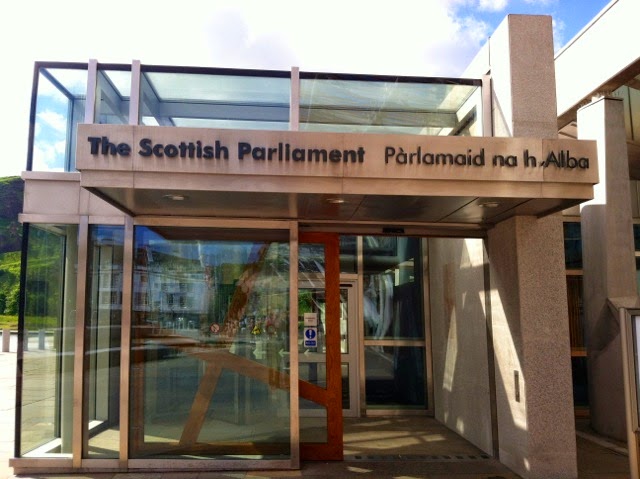
The month of July was spent speaking with people from outwith parliament involved in the independence debate. I spoke with members of Yes Scotland (the umbrella organization that is pro-Scottish independence and constituted by the Scottish National Party, the Scottish Green Party, and the Scottish Socialist Party), canvassed with a local Edinburgh chapter, and attended several local events put on by organizers.


Speaking with Better Together (the umbrella organization that is anti-Scottish independence and constituted by the three main Westminster parties, Labour, Conservative, and Liberal Democrat) proved more difficult, as they did not seem to be eager to speak with me.


Nonetheless, the month of July was very exciting and allowed me to view a side of the independence debate that was very different than what I had experienced at the Scottish Parliament; particularly in regards to the vibrant grassroots movement than characterizes Yes Scotland, and the multitude of organizers who are not involved with the Scottish National Party as members or voters, and are campaigning for an independent Scotland for reasons separate to that of the Scottish National Party. Thus, my research this summer was invaluable to my understanding of what is currently taking place in Scotland, and will pay incredible dividends towards my dissertation.

Thursday, July 17, 2014

A Stint in Budapest

Christopher Vandemark, an undergraduate student here at the University of Florida, as well as our ardent coordinator at the American Hungarian Educators Association conference this past May, was awarded a Summer travel grant from the Center to assist with his thesis research in Budapest, Hungary. He reports to us his experiences below:
    
Thanks to the travel grant afforded me by the Center for European Studies, I had the opportunity to research for my undergraduate thesis on nineteenth-century Hungarian history in Budapest. The academics and young people that I met with on the trip were instrumental in helping me crystallize a topic that suited my scholarly interests. In addition, meeting with historians who share my fascination with Hungarian aesthetics equipped me with invaluable resources that would not have otherwise been available to me in the States.  
Perhaps the most exciting aspect of my trip to Hungary was the opportunity to meet with Simonovics Ildikó, curator of the Kicselli Museum in Budapest, and a prominent Hungarian fashion historian. With her guidance, I was able to locate an abundance of primary source material, including issues of Pesti Divatlap, a famous fashion publication from the middle of the nineteenth century. Working through the publications with which I was provided, primarily by Dr. Simonovics, I have chosen to write my thesis on Hungarian fashion as an instrument of passive resistance against the Habsburgs in the middle portion of the nineteenth century. The failed revolution of 1848 proffered an opportunity for subjugated populations of Hungarian society, namely women, to participate in the movement against Austrian supremacy. Using these publications as a guide, I hope to compose a paper which highlights the intersections between nationalism and aesthetics as a means of feminine empowerment.      
While the bulk of my trip was spent researching and meeting with various academics, I made time to enjoy the youth culture of Budapest in an effort to, not only have a good time abroad, but to improve my Hungarian language skills. I met so many fascinating, friendly individuals at the plethora of ruin pubs, bars, and clubs that line Budapest’s party district. As a college student, the connections I made in these clubs were probably the most memorable part of my visit. Meeting people from across the globe, and swapping stories about our experiences abroad was unforgettable.
I am grateful to have had the opportunity to the visit the city that I have read so much about over the course of my studies; in a sense, it was like putting a face to the name of pen pal you’ve been communicating with back and forth for years. Without a doubt, my thesis will be of a much higher quality because of this journey, due to the primary sources I collected, as well as the people, both my peers and academic superiors, with whom I was able to spend time with.

*CES travel grants are open to all UF graduate students regardless of discipline as long as the subject of the research or talk is related to contemporary Europe (i.e. it is not sufficient that the trip takes place in Europe, it must be about contemporary Europe, broadly defined). Follow the link here for more information: http://sites.clas.ufl.edu/ces/fellowships-2/student-fellowships/graduate-student-travel-grants/

Tuesday, June 17, 2014

An Oral History Exhibit

We were honored to win the support of the Delegation of the European Union to the United States this year. Together with Eastside High School's IB students and the Samuel Proctor Oral History Program (SPOHP), the Center was able to burgeon a rare Historical and visual experience, the 'Getting to Know You' oral history exhibit. In it, Eastside students appended a colorful context to the Historical narratives of Europeans who now live in Gainesville. They conducted video interviews with SPOHP's counsel, painted and photographed, and exhibited their work in the Thomas Center Mezzanine Gallery. Below are some photos from the exhibit opening:


Dr. Freifeld mingles with the group


We are happy to say the oral history exhibit is free and open for the public to view from Monday-Friday: 8 a.m.-5 p.m. until Saturday, June 21st, at 4pm.  Do try to make it out for this unique experience! If you're not in Gainesville proper, videos are available to view on Eastside's IB Oral History Project website: http://eastside.sbac.edu/pages/EHS0421/5130169170831539170/IB_Program/IB_Oral_History_Project

Thursday, June 5, 2014

The CES offers an annual competition for student and faculty travel grants. This past Spring, we awarded multiple grants of up to $1,000 to assist those avidly pursuing their research, and/or presenting work at a scholarly conference or workshop.  Ana María Díaz Collazos, PhD in Hispanic Linguistics, was one of our grantees, and wrote to us on her unique experience in America's Dairyland:


Travel Report


            I attended a conference called 7th International Workshop on Spanish Sociolinguistics, which took place in Madison, Wisconsin, on April 3-5. I arrived one day before it started and left one day after. I stayed four nights in the conference hotel. My presentation was scheduled for Saturday, april 5th, at 11:00 a.m., which was entitled “Pronouns of Courtesy between Angels and Demons in Colonial Hispanic America: Social or Spiritual Forces?” I also chaired a panel entitled “Subject Expression,” Friday, April 4th, at 9:00 to 10:30. Beyond these fixed commitments, I participated actively during the three days of schedule by attending to the panels and asking questions or making comments. This allowed me to meet many potential employees.
            Among the presentations I attended, I had the opportunity to learn about the existence of many varieties of Spanish in contact with other languages. For example, there are many English-based Creole languages in Central America, as I learned from the presentation by Ashley LaBoda on the Limonese Creole in Costa Rica (April 3rd). There is also a community of Mennonites who migrated from Paraguay to Canada who blend Spanish, English and a Germanic dialect already disappeared from Germany (April 4th).  In the session I chaired, there was an important professor whose name is Ana Maria Carvalho, who shared her recent research on Spanish in contact with Portuguese in the Uruguayan border with Brazil. I also attended a session on language ideologies in Spain, where the speakers highlighted the increasing prestige of traditionally marginalized languages such as Galician or Catalan (April 5th). One of the keynote speakers, Sally Tagliamonte, spoke about the most recent trends in quantitative methods for sociolinguistic research. Her presentation was very interesting and useful to plan methodologically my future research.
I was able to interact socially with Irene Moyna, who is editing a volume for which I will contribute a chapter. She introduced me to some other professors and potential employees. I presented a topic related to my contribution for the book, which has to do with the usage of terms of address in authors of Spanish descent in Hispanic America. They were three authors who wrote mystical poetry in 1561, 1650 and 1703. In their poetry, they take advantage of archaic meanings of Spanish second person pronouns to represent the speech of supernatural entities acting as characters of their books. In Spanish there three second person pronouns in the singular. Each of them signals the intrinsic power in every relationship. Thus, the attribution of certain pronouns to angels or demons implies a perception of power as a fixed, unchangeable structure. I received interesting feedback from the audience. For example, that it would be good to explore the lives of these authors to discover the literary works they had access to. In this way, I would enrich the analysis by showing the literary paths of transmission for these archaic usages of pronouns.
My talk was part of a panel related to terms of address organized by Irene Moyne. This panel took place in the morning of April 5th. I attended all other presentations of the panel and obtained an invaluable amount of information on the newest trends in research on terms of address. I had the possibility to network with these researchers, who are also contributors to the volume to be edited by Irene Moyna. This was a unique opportunity to increase my network in a sensitive period of my career as is transition from a Ph.D. student to a professor in my last year of studies. The travel grant from the Center for European Studies made it possible.


We currently have students and faculty in Budapest, Moscow, Poland, Brussels (to name a few). Keep your eyes peeled for their reports when they're writing on our stomping grounds again.


*CES travel grants are open to all UF graduate students regardless of discipline as long as the subject of the research or talk is related to contemporary Europe (i.e. it is not sufficient that the trip takes place in Europe, it must be about contemporary Europe, broadly defined). Follow the link here for more information: http://sites.clas.ufl.edu/ces/fellowships-2/student-fellowships/graduate-student-travel-grants/

Tuesday, May 27, 2014

Updates

When the flurry of Spring turns to Summer semester the day after Memorial Day, it has one not forging forward but first, reflecting back. Indeed the promised art exhibits, oral history exhibits, Viva Europe! festival, conferences and Spring panels all happened. In fact we had five events in January alone. To name a few, our beloved Anna Muller, who now teaches at the University of Michigan, returned to us mid-January to give the fascinating talk, "Mother Solidarity: Anna Walentynowicz's Path to Opposition - An Exercise in Memory Studies." To close out this graupeling month we, in conjunction with the Center for Women's Studies and Gender Research, had a film screening of the documentary called "In the Name of Love: Mail Order Brides" at The Wooly in downtown Gainesville.

In February we managed to hire our new office manager, Cecilia Greco, UF alumna and CES enthusiast, who conceded to move from the simpering grip of Chiberia and shortly thereafter, comfortable at her newly darned desk (thanks to our CES toolkit), established our first-ever Twitter page, https://twitter.com/UFCES.

In the mix, revolution gripped Ukraine, and we invited scholars to bid us new perspectives on the Ukrainian situation at our "Ukraine, Russia, and the European Union: Legacies of the Past" panel in March. One among the panel is the pictured Keith Darden, a quizzical Political Scientist from American University.

Keith Darden
In April after the sights and sounds of Viva Europe! flickered in Bo Diddley Plaza, Valerie Sperling's talk "Sex, Politics, and Putin" garnered much attention at UF. Such was particularly true in the flyer department, where some mysterious soul set to dressing Putin proper for the event:
Before
After
The Ukrainian situation has since stabilized and, from the eve of Presidential elections this past May 24th, Chocolate Putins (hand-over-heart, bomb behind) fly off the shelves in Lviv.


The final reflection-cajoled update plods to the present with mention of the "Getting to Know You: Our Neighbors of European Heritage" oral history exhibit, which opened in May and will be housed at the Thomas Center until June 21st, 2014. 

A moving video compilation put together by Eastside High School students and the Samuel Proctor Oral History Program for "Getting to Know You: Our Neighbors of European Heritage" is available to view here: https://www.youtube.com/watch?v=TeBmMpuvPxo. As is Eastside High's index of individual interviews: http://eastside.sbac.edu/pages/EHS0421/5130169170831539170/IB_Program/IB_Oral_History_Project.

Alas, we conclude this post-Memorial Day update with Cecilia's avowal to resurrect this blog and keep us all in loop with CES news through the Summer. Until next time, friends.


Wednesday, November 27, 2013

Thanksgiving

Welcome to Eurogator's Thanksgiving edition!  We have much to be thankful for today - adequate lighting (thank you Vincent McLeod), no lines at Starbucks, grant applications filed on time, funny news stories (see for instance Russia's attempt to get its citizens in shape and in the mood for the Olympics by offering free subway rides for a few squats http://www.forbes.com/sites/andrewbender/2013/11/14/moscow-subway-station-lets-passengers-pay-fare-in-squats/), etc.  But alas, such is the deserted university campus on a day before a holiday break.  We truly do have much to be thankful for though and we hope that everyone has a safe and enjoyable break.  With any luck, most of you will be able to spend some time at home with friends and family and not have to worry too greatly about upcoming exams, papers, and other assorted academic assignments.

One of the things that I am most grateful for at this moment is Santa Fe College's Global Society.  As part of our Getting to Know Europe grant, the Global Society club will be working with local area high school students on a model EU competition.  Rachel Rothstein and I had the absolute pleasure of meeting with the club's Vice President and President, Catherine Barrios and Roberto Garcia respectively, a couple of weeks ago and we were very impressed with their proposal.  Talk about two students with bright futures ahead of them!  Here's what Catherine had to say about their group:

"Global Society was founded in 2000 at Santa Fe College for the purpose of providing students with a deep interest in international affairs.  It is a group to socialize, and eventually, participate in Model United Nations conferences.  Since its inception, Global Society has managed to win awards and recognition at these conferences nationwide.  We compete against Ivy League and major universities by portraying our chosen country as accurately and diplomatically as possible.  This allows an opportunity for students with an interest in engaging as a UN delegate and in attempting to resolve major world issues to learn more.  As for our campus events, Global Society hosts lectures, fundraisers, dignitaries, and other social events throughout the semester.  Thus, we are active throughout the year by preparing for these events and partaking in them.  Global Society events consistently deliver a global message to the campus and community participants in an attempt to spread multicultural awareness.  

We are looking forward to working with UF's Center for European Studies on this special project.  It is our hope that we can increase awareness of how the European states collaborate, the importance of the European Union, and introduce current issues affecting this region of the world to the high school students and our community as a whole." 

Until next time, have a happy Thanksgiving and enjoy the long weekend!

Monday, October 28, 2013

Bei Mir Bist Du Schoen.......or why study Yiddish at the University of Florida

Welcome to yet another entry from the Center for European Studies at UF.  We are still in the midst of preparations for our Getting to Know Europe events and talks.  The upcoming Spring semester will prove to be a very busy time indeed as we will host art exhibits, oral history exhibits, and numerous talks.  Not to mention our annual Viva Europe festival!  We are also listing some very interesting courses in the Spring semester and to that end I would like to introduce our newest course, Yiddish Language and Culture, taught by Professor Dror Abend-David.  In the upcoming weeks I will include more information about other CES-sponsored courses, but let's focus on Yiddish for today.  By the way, this is the first time that Yiddish has been taught at a Florida university and it is generating quite a bit of attention, so enroll quickly if you would like a seat!  See the Alligator article for an interview with Professor Abend-David http://www.alligator.org/news/campus/article_80a30f2c-3621-11e3-9aed-0019bb2963f4.html.

Yiddish offers a rich cultural heritage, from great theater actors and directors, such as Esther Ruth Kaminska (whose great-granddaughter Ruth would later marry the extraordinarily talented trumpet player and band leader Eddie (Ady) Rosner - Rosner's life story, which was truly something, was covered in the 1999 documentary "The Jazzman from the Gulag" - http://www.medici.tv/#!/the-jazzman-from-the-gulag) to song writers, such as Jacob Jacobs and Sholom Secunda.  Jacobs and Secunda wrote the classic "Bei Mir Bist Du Schein/Schoen," which ironically was a huge hit in Nazi Germany.  Check out the Andrews Sisters and their version http://www.youtube.com/watch?v=4Vvo3MaFcxw.  For more on the history of the song, http://yiddishradioproject.org/exhibits/ymis/?pg=2.  But enough about jazz and more from Professor Abend-David on how he came to study Yiddish and why it is such a valuable undertaking:  

"not so loud – he thinks he's learning English"
 In his novel, Operation Shylock, Philip Roth includes an old anecdote about a customer who is very impressed with a Jewish restaurant on the Lower East Side. He compliments the owner on the great food and service, and the Chinese waiter who speaks excellent Yiddish. "Not so loud…" says the owner, "…he thinks he's learning English."

I will share this anecdote next semester when I teach UF’s first Yiddish Language and Culture class (HBR 4930, EUS 4930, JST 4930). But what I probably will not tell my students is that this anecdote is in some way a part of my life story. I attended both high school and graduate school in the United States and at the age of sixteen I fell in love with the poetry of T. S. Eliot and decided to study English Literature. Much like the case of the Chinese waiter in Roth's anecdote, Yiddish was an uninvited, sometime uncomfortable detour that the move from my native Hebrew Literature into English and American Literature necessitated.

As I was studying for a master's degree in English Literature at SUNY Binghamton, I couldn't help but compare the poetry of Emily Dickinson to that of a number of Modern and Contemporary Hebrew Women Poets.  The conundrum of where some of the earlier Hebrew Women Poets might have read or even heard of Dickinson was solved in the most unexpected manner. While Dickinson's great acclaim only began in the 1950's, and the first translations of her work into Hebrew didn’t appear until much later, Dickinson was already translated into Yiddish in 1927 by Michel Licht.  Licht in fact predicted that she would be recognized as one of the most significant Modern American Poets.

Consequently, when I decided to write a paper on Emily Dickinson, I found myself at the Institute for Yiddish Research (YIVO), then on Fifth Avenue in New York City. While at YIVO I met with the legendary Dina Abramowicz who was impressed by how little I knew about anything – but since I was a Litvak (a Lithuanian Jew, like her) she gave me the benefit of the doubt. I had the further benefit of meeting Djelal Kadir, a former editor of World Literature Today, who chose to publish one of my first papers on this stumbled-upon topic.  And Kadir’s request was even more unexpected as I had presented my paper to a completely silent audience that had neither comments nor questions. With the impending publication of my paper, Yiddish no longer seemed only a detour to from my true vocation. 

Looking back, I can certainly understand why my mentors in the English Department at SUNY Binghamton couldn't make heads or tails of what I was doing. My preoccupation with English, Hebrew, Yiddish and eventually German, forced me to move slightly away from the English department, and I soon found myself at the Comparative Literature department at New York University. My Mentor, Prof. Richard Seiburth, suggested that I combine my interest in Shakespearean Drama, Hebrew and Yiddish, and Theory of Translation into a dissertation that would compare the German, Hebrew, and Yiddish translations of The Merchant of Venice. With this dissertation I became a scholar of Comparative Jewish Literature and Translation Studies. The dissertation itself was published immediately as a book by Peter Lang and received the Koret Jewish Publications Program Award.

Over the past ten years I've taught Yiddish, Hebrew and English in various venues and I have found inspiration for my courses and scholarly work in the most unexpected places and texts. A famous children’s book that tells about a violent group of people who takes over the government and persecutes innocent victims on the basis of their ancestry and purity of blood, has led to my course, Harry Potter and the Holocaust, which covers a variety of issues, such as Imagism and Modern Poetry, Modern Jewish History, the Holocaust, and Children’s Literature.

The study of Yiddish language and culture cuts across many different disciplines and often reveals connections that might otherwise be invisible.  For instance, I recently participated in a symposium at the University of Toronto, Jewish Literature beyond Borders (http://www.cjs.utoronto.ca/jewishliteraturebeyondborders). For this particular symposium I gave a talk on a 1923 film version of The Merchant of Venice that was directed by Peter Felner and starred a German cast.  However, according to a 1924 review in the Warsaw Yiddish press, this production was presented as "our just revenge against non-Jewish persecution."  The film was therefore both "translated" into Yiddish and repackaged as a Philo-Semitic production.  So I ask, does this topic fall within Yiddish Studies or Film Studies?  Or, maybe it could possibly be a subject for Translation Studies or a Cultural Studies course? While it is difficult to pinpoint just which discipline it should fall under, the option of so many different approaches demonstrates the wealth of diversity that Yiddish language and culture has to offer.